
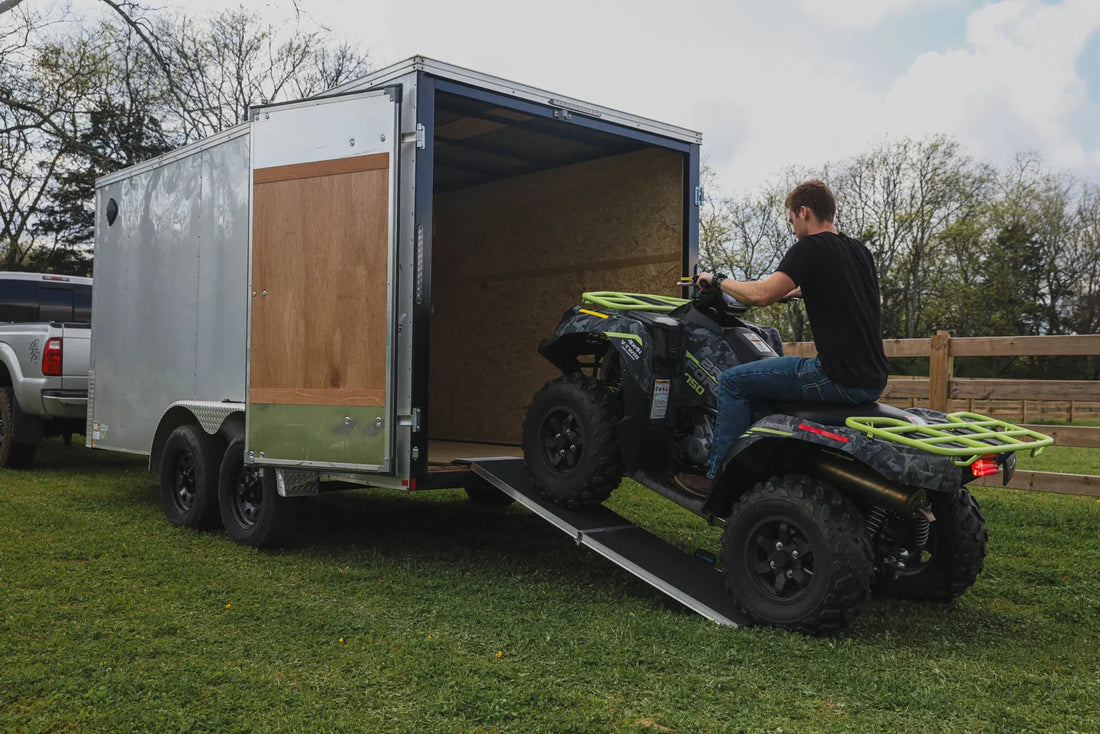
Winter storage prep for ATVs, motorcycles, and powersports equipment
When riding season ends, every ATV and motorcycle needs somewhere to wait out the winter: a garage, a shed, a storage unit, or a trailer parked for the season. Getting it there usually means loading a machine that can weigh several hundred pounds.
Plenty of guides cover the standard winterizing checklist. This one focuses on the step that gets less attention, which is loading and transport. We’ll start with safe loading practices, then finish with a brief maintenance rundown.
Why the loading step matters most
Most winterizing tasks happen with the machine parked and the engine off. Loading is different. You’re moving a heavy vehicle up an incline, often on your own, and often in cold, damp conditions. A mistake at this stage tends to cost far more than a skipped fluid check.
A mismatched ramp is one way these loads go wrong. A ramp that is too narrow for the tires, too short for the bed or trailer height, or not rated for the machine’s weight can make a tip-over more likely, especially when nobody is there to help steady the load. Choosing the right ramp before the first load is the simplest way to reduce that risk.
Choosing the right ramp for ATV and motorcycle storage
The STRAPLESS® Centerfold ATV Ramps are 14.3 inches wide, come in 6-foot and 8-foot lengths, and have a weight capacity of 1,100 pounds per set. The STRAPLESS Centerfold Motorcycle Ramps share the same 14.3-inch width and 6-foot and 8-foot lengths, with a 550-pound weight capacity. For motorcycles, use the loaded weight, including fuel and any gear, when you compare against that rating.
Both ramps use the patented Top Lip Extension (TLE) to attach to a truck bed or trailer without tie-down straps. That helps keep the ramp seated while you load, which matters most when you’re working alone. Each ramp is made from aluminum with a gritty tread surface for traction in wet or muddy conditions, and each folds in the center for storage.
Length also matters. For the same bed or trailer height, a longer ramp creates a gentler angle, so the 8-foot option is worth a look if you’re loading into a taller truck bed.
Safe loading practices for winter storage
A few habits make the biggest difference, especially in cold weather:
- Confirm the ramp is seated first. Make sure the TLE is engaged on the truck bed or trailer and the ramp isn’t shifting before any weight goes on it. A ramp that moves mid-load is a problem you want to rule out in advance.
- Clear the surface. Snow, ice, and wet leaves on the ramp, or on the ground at its base, reduce traction. The gritty tread helps in wet or muddy conditions, but it isn’t a substitute for clearing ice.
- Drive ATVs up slowly in low gear. Keep your weight centered, hold a steady throttle, and avoid stopping or shifting your weight partway up.
- Walk motorcycles up, don’t ride them. Guide the bike up the ramp on foot, keeping it upright and centered. If you’re using a motorcycle ramp, set it up so you have room to walk beside it.
- Bring a second person for heavier loads when you can. An extra set of hands makes it easier to steady the machine if it starts to lean.
Strapless refers to how the ramp attaches to your truck or trailer. Once the machine is loaded, it still needs to be secured for transport.
Rounding out your winter storage routine
Once the machine is loaded and stored, the standard steps apply. Add fuel stabilizer or drain the fuel, depending on your tank material and manufacturer guidance. Connect a battery maintainer or follow your manual’s battery storage instructions. Wash and dry the machine, then cover it with a breathable cover. Your owner’s manual is where to check for specifics on your model.
Frequently asked questions
How do I safely load my ATV for winter storage?
Start with a ramp that fits the machine. The STRAPLESS® Centerfold ATV Ramps are 14.3 inches wide and rated for 1,100 pounds per set. Seat the ramp securely, clear off any snow or ice, then drive up slowly in low gear with your weight centered. Bring a second person if possible.
What is the best way to store a motorcycle for winter?
Begin with safe loading, using a properly rated ramp and walking the bike up instead of riding it. Then follow standard storage prep: manage the fuel, keep the battery maintained, wash and dry the bike, and cover it. Check your owner’s manual for model-specific steps.
Do UTVs need different winterizing than ATVs?
The core steps apply broadly: fuel, battery, cleaning, and a cover. The differences are mostly size and weight, since UTVs tend to be wider and heavier. Before loading one, check its weight and tire width against the ramp’s width and capacity rather than assuming it will fit.
Should I store my ATV or motorcycle with a full or empty gas tank?
It depends on the tank material and the manufacturer’s guidance. Some owners fill the tank and add stabilizer, while others drain it. Your owner’s manual will tell you which approach suits your machine, so check it before you choose.
Next steps
If you’re hauling an ATV or motorcycle to storage this season, check the ramp before the machine. Browse the ATV ramps and motorcycle ramps collections to compare STRAPLESS® options for loading safely on your own ahead of winter.
Summary and key takeaways
- Loading is the step where a mistake tends to cost the most, and it often gets the least attention in a winterizing routine.
- The STRAPLESS® Centerfold ATV Ramps are 14.3 inches wide with a 1,100-pound capacity per set, and the Motorcycle Ramps have a 550-pound capacity, both in 6-foot and 8-foot lengths.
- Seat the ramp, clear off ice and snow, and take it slowly: low gear for ATVs, on foot for motorcycles.
- Treat loading as the first and most important step in your winter storage routine, then move on to fuel, battery, cleaning, and cover.